Fill-in Word: Crossword Puzzle
CASUAL AZUR GAMESWord
4.96.00 Reviews
- Version
- 6.2.3
- Installs
- 10.00K
- Age Rating
- Teen
Screenshots
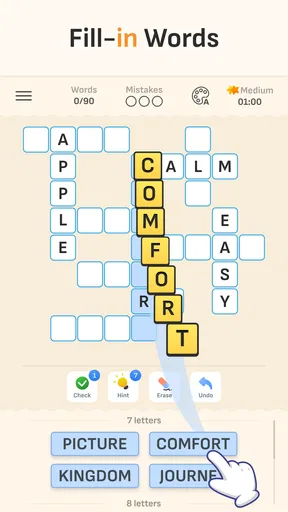

Our Review of Fill-in Word: Crossword Puzzle
 Analysis by Appyee
I usually approach word games expecting a pleasant few minutes rather than a memorable atmosphere, but Fill-in Word: Crossword Puzzle made a stronger first impression than I expected. It is a free word game from CASUAL AZUR GAMES built around filling crossword-style entries, yet its appeal is not limited to testing vocabulary. The central pleasure comes from the way each answer gradually clarifies the surrounding puzzle, turning a small uncertainty into a satisfying chain of deductions.
The store summary calls it a brain and logic game, and that description fits better than calling it a simple spelling exercise. I found myself switching between language knowledge, pattern recognition, and careful elimination. A familiar word can still be difficult when its position in the grid is unclear, while an unfamiliar answer may become obvious once a few crossing letters are in place. That balance gives the game a quietly thoughtful mood rather than a frantic one.
It is also easy to understand what I am getting before installing it. The short description identifies the format as fill-in word play, and the game belongs squarely in the word category. It is free to start, carries a Teen content rating, and supports devices running Android 7.0 or later. Those details make it approachable for many players, although the age label is still worth checking if the game is intended for a younger player.
A calm word-game mood built from clues, crossings, and pauses
I find this kind of word game works best when I treat the board as a set of connected possibilities, not a row of isolated blanks. Starting with the entries I’m most confident about can give the trickier sections useful letter anchors, while a short pause often helps more than forcing a guess. That steady, low-pressure approach sets up a closer look at how the game’s crossings shape each session.
The first few puzzles explain the appeal quickly
My first impression was that the game asks for attention without demanding total concentration. I could look at the available spaces, try an answer, reconsider it when the crossing letters disagreed, and continue without feeling punished for taking a moment. That pacing suits the kind of play I want on a short break, especially when I am not in the mood for a competitive game or a long story-driven experience.
The most effective part of the presentation is the gradual reveal. A nearly empty puzzle can feel vague, but every correctly placed word gives the next decision more shape. I like that the board itself becomes the source of momentum. Instead of relying on constant visual spectacle, the game creates progress through small changes in the arrangement of letters.
This also means that the experience depends heavily on how comfortable you are with word puzzles. If you enjoy crosswords, fill-ins, and logic-based deduction, the basic structure is immediately inviting. If you prefer action, colorful collection systems, or a strong narrative, the restrained format may feel too quiet. The game knows what it is, and that clarity is one of its strengths.
Art direction that supports concentration
The visual identity works best when it stays out of the way of the grid. In a word puzzle, decoration has to create a pleasant setting without competing with letters and spaces. Here, the overall impression is more about readability and progression than visual drama. I did not feel that the presentation was trying to turn a simple clue into something larger than it needed to be.
That restraint gives the game a coherent playable mood. The board is the main visual object, and the act of completing it supplies the sense of movement. Each filled section makes the puzzle look more resolved, which is a small but meaningful reward. For me, that visual feedback is more useful than elaborate effects would be because it reinforces the actual task.
There is a trade-off, though. Players who need a constantly changing environment may find the presentation modest. This is not the sort of word game I would choose for visual variety alone. Its atmosphere comes from order, empty spaces becoming complete, and the quiet satisfaction of seeing a difficult section finally make sense.
Sound and rhythm matter more than they first appear
Word games can become tiring when every move feels identical, so rhythm is important even when the rules are simple. Fill-in Word: Crossword Puzzle benefits from a measured tempo. I can work through a clue, pause, scan the crossings, and make a decision without the game feeling as though it is pushing me toward hurried guesses.
That slower rhythm also makes it suitable for everyday situations. I can imagine opening it while waiting for an appointment, during a commute when conditions are safe for phone use, or after dinner when I want something more active than scrolling but less demanding than a full game session. A single puzzle can occupy a short window of attention, while a more stubborn section gives me a reason to return later.
I would not describe the sound design as the main reason to play. The game’s strongest sensory quality is its quiet focus, not a dramatic soundtrack or a cinematic audio identity. That may disappoint anyone looking for a highly expressive soundscape, but I see the understated approach as appropriate. Loud or overly busy audio could easily interfere with the mental rhythm that makes this format enjoyable.
Why the setting feels playable rather than decorative
There is no need for a complicated fictional world in this kind of game. The setting is essentially the puzzle space itself, and that works because the clues and grid provide their own sense of place. I move through a mental landscape of partial answers, intersections, and discoveries. The atmosphere is created by the act of solving rather than by a story layered on top.
That design choice keeps the focus honest. The game does not need to pretend that a crossword is an adventure map or that every completed entry is part of a grand narrative. Instead, the setting supports a reflective style of play. When I am stuck, the empty spaces invite inspection; when I solve a section, the completed pattern gives a clear feeling of arrival.
This is also where the game differs from many casual alternatives. A match-three title often uses speed and visual effects to maintain energy, while a trivia game usually depends on quick questions and immediate judgment. This puzzle asks me to build an answer from relationships on the board. The mood is consequently more patient, and the reward is more analytical.
How the mechanics and atmosphere reinforce each other
The core mechanic is straightforward: fill the word entries and use the crossing letters to guide the next choices. What makes it work is the way the mechanic naturally produces pacing. I am not merely entering isolated answers. I am testing how one decision affects several connected spaces, which creates a gentle form of pressure without requiring a timer or an opponent.
One useful approach is to begin with the entries that feel most certain, even if they are not the longest or most interesting. Those answers create anchors for the surrounding spaces. Once several crossing letters are visible, uncertain clues become easier to interpret. I found this more reliable than repeatedly attacking the hardest-looking entry and hoping it would suddenly become obvious.
A second useful habit is to treat a doubtful answer as a temporary hypothesis rather than a commitment. If a word seems plausible but makes multiple crossings awkward, I go back and inspect the letters around it. This prevents one early guess from distorting the rest of the puzzle. The game rewards that kind of flexible thinking because progress often comes from correcting the structure, not from forcing a single clue.
A third tip is to use short sessions strategically. When I reach a section that feels blocked, stepping away can be more productive than staring at the same spaces. The puzzle’s calm rhythm makes it easy to return without losing the sense of where I was mentally. That is a practical advantage over games that depend on continuous momentum or a narrow timing window.
Where it fits among familiar word-game alternatives
Compared with a traditional crossword, this game feels more approachable when I want the satisfaction of crossing letters without committing to a newspaper-style solving session. The fill-in structure gives me visible support as I progress. It is still possible to get stuck, but the grid offers a steady stream of partial information.
Compared with a word-search game, it asks for more reasoning and less visual scanning. Word searches are excellent when I want a quick pattern hunt, while this game is better when I want each answer to influence the next. Compared with an anagram game, it gives more weight to placement and context than to rearranging a fixed group of letters.
That does not make it universally better. Someone who loves fast rounds, competitive leaderboards, or a large social component may prefer another style of word game. I would also choose a more traditional crossword product if I specifically wanted dense clues, a strong editorial voice, or a newspaper-like challenge. Fill-in Word: Crossword Puzzle is most convincing as a relaxed, accessible logic-word hybrid.
Who will get the most from it
I think the best audience is anyone who enjoys word solving but wants a flexible pace. It suits players who like to make progress through small deductions, people looking for a low-pressure mental break, and anyone who prefers a board that explains its own logic through crossing letters.
It can also work well as a shared casual activity. I can imagine two people looking at a difficult entry together, suggesting possibilities, and using the grid to decide which idea fits. Because the mechanics are easy to explain, it does not require a long tutorial before another person can participate.
The game is less suitable for players who need constant novelty. If your ideal mobile session includes rapid reactions, character development, competitive matches, or a changing story, the quiet word-puzzle structure may not hold your attention for long. It is also not the right choice when you want a completely effortless distraction; even its relaxed mood still asks you to think.
Free access and the practical trade-offs
The game is free to download, which makes it easy to try without making an immediate commitment. Optional in-app purchases range from $0.99 to $19.99 per item, so I would approach the purchase side with the same awareness I use for any free-to-play puzzle. The important question is whether the basic solving loop already feels satisfying before spending anything.
For me, the answer is yes: the grid-and-crossing relationship is strong enough to judge on its own. I would recommend playing naturally first, learning which clue types suit you, and deciding later whether optional purchases add meaningful convenience. That order matters because hints can solve a moment of frustration, but relying on them too quickly can reduce the very deduction that gives the game its character.
This is one of the game’s clearest trade-offs. A hint can preserve the flow and keep a short session enjoyable, but solving the difficult entry independently usually creates a better sense of accomplishment. Players who want every puzzle to remain a personal challenge should be careful not to turn assistance into a habit. Players who mainly want a calm pastime may reasonably value convenience more.
What the current release means for choosing it
The current version is 6.2.3, and the game has reached over ten thousand installs. Its average rating is 4.9 from around sixty-five ratings, with six written reviews. Those figures suggest a positive early reception, but I would still treat them as a small snapshot rather than a complete verdict. The more useful test is whether the game’s pace and puzzle format match the way you like to play.
Its developer, CASUAL AZUR GAMES, has positioned this release clearly within casual mobile entertainment rather than presenting it as a specialist crossword tool. That makes sense for the accessible structure. I would recommend checking the device requirements before installing on an older phone, since Android 7.0 is the minimum operating system listed for the game.
My final atmosphere verdict
Fill-in Word: Crossword Puzzle succeeds because its mood grows directly from its mechanics. The art direction keeps attention on the board, the sound and pacing leave room for thought, and the setting does not distract from the pleasure of turning uncertainty into a completed pattern. I appreciate that the game does not need frantic energy to make a correct answer feel rewarding.
Its limitations are equally clear. The presentation may feel understated to players who want spectacle, and the format will not replace a full crossword experience for people seeking dense clues or a strong editorial personality. The free-to-play structure also deserves sensible handling, particularly if hints become tempting during difficult sections.
Still, I would recommend it to a friend who wants a word game that can fit around real life. It is a good choice for a quiet break, a short mental reset, or a longer session built from one thoughtful decision after another. Its best quality is the way every solved entry improves both the puzzle and the atmosphere: the board becomes clearer, the rhythm becomes more confident, and the game’s calm identity feels earned rather than merely decorated.
Verdict
Strengths of Fill-in Word: Crossword Puzzle
- Simple rules make it easy for beginners to start playing.
- Short puzzles fit well into quick breaks or daily routines.
- Helpful hints can prevent players from getting stuck.
- Offline play makes it convenient when no internet is available.
- Gradual difficulty provides a satisfying sense of progression.
Limitations of Fill-in Word: Crossword Puzzle
- Some clues may feel repetitive after extended play.
- Hints or extra features may be limited without in-app purchases.
- Small text can be difficult to read on compact phone screens.
- Puzzle quality may vary between different themed packs.
- Frequent reminders or ads can interrupt the solving experience.
Other Releases by CASUAL AZUR GAMES
View All
Worms Zone .io - Hungry Snake
Action4.3

Stack Ball - Crash Platforms
Arcade4.5

STAR: Super Tricky Amazing Run
Arcade4.2

State.io — Conquer the World
Strategy4.1
Similar Picks in This Category
View All
Word Search - Word Puzzle Game
Bluetile4.8

Word Search Quest - Puzzles
Blackout Lab4.8

CodyCross: Crossword Puzzles
Fanatee, Inc.4.7

Words of Wonders: Crossword
Fugo Games4.9

Wordscapes: Word puzzle game
PeopleFun4.7

Word Search Explorer
PlaySimple Games4.9
Frequently Asked Questions
What is Fill-in Word: Crossword Puzzle?
Fill-in Word: Crossword Puzzle is a word game based on completing crossword-style grids with the correct answers. Instead of simply solving clues, players typically use a selection of words or letters to fill empty spaces and gradually complete each puzzle. It is designed for casual play, vocabulary practice, and relaxing sessions, with progressively challenging levels that can suit both beginners and experienced puzzle fans.
How do you play Fill-in Word: Crossword Puzzle?
To play, examine the puzzle grid and the available clues, words, or letter options shown on the screen. Tap the appropriate space and enter the answer that fits the clue and the crossing letters. Correct entries help reveal more of the board, while mistakes may need to be removed or corrected. The game becomes easier as completed words provide hints for the remaining spaces.
Is Fill-in Word: Crossword Puzzle free to download and play?
The application can generally be downloaded at no initial cost, allowing users to try its basic puzzles without paying upfront. However, free versions of word games may include advertising, optional purchases, or paid features such as hints, extra coins, ad removal, or additional content. Before downloading, check the store listing and in-app purchase information, especially if children may use the device.
Can Fill-in Word: Crossword Puzzle be played offline?
Some puzzles may remain available without an internet connection after the necessary game content has been downloaded, making the app convenient for travel or areas with limited coverage. Nevertheless, online access may still be required for advertisements, cloud synchronization, updates, leaderboards, or certain bonus features. Offline availability can also differ between versions, so it is worth testing the game after enabling airplane mode.
Is Fill-in Word: Crossword Puzzle suitable for beginners and children?
The game can be suitable for beginners because crossword-style levels usually introduce familiar words before gradually increasing the difficulty. Hints or assistance features may also help players who get stuck. However, the exact suitability for children depends on the vocabulary, advertising, permissions, and purchase options included in the current version. Parents should review the app’s age rating and supervise younger users when necessary.
Play our best games!


